 Mark Burgess
Every organisation ends up needing something its core systems don’t do. A task list for people who aren’t users of the system, a mobile app for field staff, a portal for suppliers, or a single modern interface for a process that runs across several systems, whether they’re in the cloud or on-premises.
Up to now there have been three ways to get it.
Buy seats, and the person who approves two requisitions a month pays the same licence as the clerk who processes four hundred. Licence counts end up tracking headcount rather than workload, and the cheaper licence class, where there is one, often doesn’t cover the one transaction the occasional user needs.
Customise the core system, and three upgrades later those customisations are the reason the upgrade is a project rather than a patch cycle. Oracle eBusiness Suite (EBS) estates are full of them – custom forms, custom workflow and extensions to standard objects, all catalogued as CEMLIs. The SaaS vendors stopped you doing it at all, which keeps the upgrade path clean, but if your requirement isn’t where the vendor expects it, you wait for their roadmap.
Buy a point tool, and it’s fast to stand up and solves the seat problem with its own pricing. What catches people out is three years later, when the tool is on someone else’s price list, in someone else’s tenancy, with your data in it, and moving off it is a project nobody budgeted for.
Building it yourself was the fourth option and usually the most expensive. That is no longer the case.
Why Building It Yourself Was the Expensive Option
Three years ago, a bespoke extension beside a core system would be between a 3 to 12 month project. It took two or three people to do the design, write the code, set up the environment and run the project, and that was when it went well.
The integration was usually the hardest part. Getting two platforms to talk to each other reliably over REST APIs is fiddly work, and it’s where a lot of projects lost their time.
Then there was the database underneath. An application that holds business data needs security, auditing, backups and high availability. On an enterprise-class platform that meant a licence conversation, sizing the infrastructure and someone to patch and maintain it, which is hard to justify for one application.
What Changed
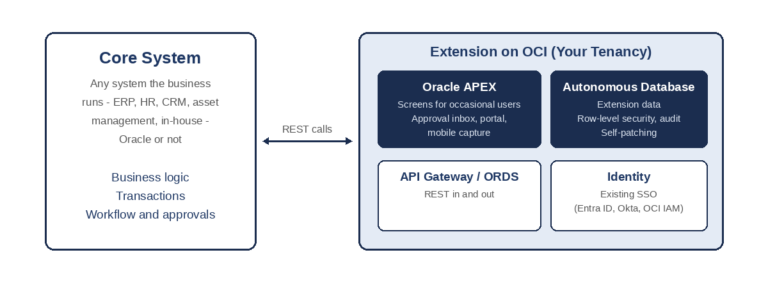
On the database side, Autonomous Database Serverless gives you the full Oracle enterprise database at an entry point small enough for a single application. It patches, tunes, secures and backs itself up, and Oracle APEX and Oracle REST Data Services (ORDS) come with it at no additional cost. You pay for the compute the application uses, not for the people who use it.
On the development side, the tooling for Oracle APEX and the database has moved on, including AI-driven development. A build that took months now takes weeks.
What a Build Looks Like Now
The front end of the process hasn’t changed much. We start with a conversation about what the business needs, write a proposal that reflects those requirements and turn that into a statement of work. From the statement of work we produce a high-level design, and once that’s approved, a detailed design.
What has changed is how quickly an approved detailed design becomes a working application. Our team builds from the design, reviews and tests what’s built, and works through the changes that always come up once people can see the real thing.
What surprised us was how much AI-driven development on Autonomous Database and APEX disrupts the conventional approach, and how much sooner the customer sees value. Delivery time used to be consumed by plumbing. Now the tools take care of the heavy lifting, and much more of the time goes on the high value work that would typically fall into the “nice to have” bucket – the great ideas the customer wants, where the time and cost never stacked up before.
Integration is where AI-driven development makes the biggest difference. The tools can survey the target endpoints, map the fields and build the data integration flows very quickly. This is typically a tedious and error-prone job for a person to do. On this platform ORDS exposes the database as REST for the core system to call, and APEX calls the core system’s REST API in return. The major SaaS platforms all publish one, and EBS has one through Integrated SOA Gateway.
A recent build shows what that adds up to. An approval inbox for a few dozen occasional approvers, sitting over the ERP’s own workflow engine and replacing a point tool, went from first conversation to production in about eleven weeks, seven of them build. Most of that time went on the design, the security model and the integration with the ERP. The screens were the quick part. Three years ago a build like this, with the security and integration involved, would have been at the upper end of that range.
We have used the same approach at both ends of the scale. One customer moved from Excel worksheets to an application on Autonomous Database and APEX, and then migrated its customer platform from a no-code tool onto the same foundation. That is a much larger application. At the smaller end, we built our own configure, price and quote (CPQ) application for the Checkmk subscriptions we sell, because our accounting system was not up to the job – a working solution in about a week.
What’s Worth Building Now
Once a build is measured in weeks, a lot of gaps that were never worth standing up a large project can now be done relatively quickly. These are the ones we see most often:
- Approval inboxes and task lists for occasional users. The core system decides who has to act, and the extension shows them the item and records the decision.
- Replacing a point tool that was only ever a front end. Customer portals built on no-code SaaS platforms are a common example. The data and the business rules were always the customer’s, so the extension brings the front end back into their own tenancy.
- Mobile apps for field staff. Inspections, readings, timesheets and requisitions captured on the device and submitted to the core system.
- Portals for suppliers and customers. External parties see and update their own records, and Virtual Private Database enforces that in the database.
- Reporting side-cars. A curated copy of core data in a database built for reporting, so the ERP isn’t carrying load it wasn’t sized for.
- One interface across several systems. A process that crosses the ERP, the CRM and an on-premises system gets one modern screen. Each system stays the owner of its own data, and the user stops switching between them.
- Workflow between two SaaS systems. Somewhere to hold state, handle retries and show the exceptions on a screen.
What the Platform Adds
An extension on Autonomous Database also gets Oracle’s newest capability the day it ships, without waiting for the core vendor’s roadmap. AI Agents in APEX 26.1 let the extension do some of the work itself – read a request, pull the data it’s allowed to see, call the actions it’s allowed to call, and hand a person the decision to confirm. Document capture reads invoices, delivery dockets and inspection reports using OCI’s document services, and presents the fields for someone to check. And a business user can ask an APEX interactive report a question in natural language, such as overdue orders by supplier for the last quarter, and the report filters, sorts and charts itself.
All of it runs in your own tenancy, in the OCI region you choose. Users sign in through the single sign-on you already have, such as Microsoft Entra ID, Okta or OCI IAM. The Enterprise Edition security features, including Virtual Private Database, unified auditing, encryption and Data Safe, are included with Autonomous Database Serverless, with no option packs to buy.
What the Tools Don’t Do
The tools aren’t magic and they don’t remove the need for human effort. We still spend time checking the code, testing the application and making sure it all works. What the tools do is streamline the process and reduce the time spent on the low value activities – the ones that take a decent chunk of time and push the cost up to the point where the business case does not stack up.
The experience of the people running the build counts for even more now. Put the tools in the hands of experienced people and you get a good result. Try doing this with inexperienced people and all you are going to do is buy a disaster faster. The tools build what the design says, and they build it fast. If the design is wrong, you get the wrong thing fast, and the rework costs far more than the time it would have taken to get the spec right up front.
Where the Source of Truth Lives
The decisions that matter are made before the build, and they’re the ones the tools can’t make for you. The most important is where the source of truth lives for every piece of data the extension touches. The extension can read from the core system, capture new data and transact against it when that’s the design. What it mustn’t do is become a second home for data the core system already owns.
The usual way that goes wrong is the organisational hierarchy. A copy starts as a convenience – a lookup so the worklist can show the next approver, or a local reassignment rule for staff on leave. It works fine at first. Months later a change lands in HR and the ERP, the copy isn’t updated, and a transaction is actioned by someone who no longer holds the authority. That’s the same failure as the point tool you retired, on a different platform. In the approval build, the hierarchy stays in the ERP and the extension only ever reads it.
What Stays With the Core System
Some things should stay with the core system whatever the design. If the ERP should post a journal or calculate tax differently, build it there. Workflow engines, approval hierarchies, delegation and notifications are usually things the vendor does well, so put a better front door on the vendor’s engine rather than rebuilding it. And if six people will use a tool for one quarter, a spreadsheet is still the right answer.
Thinking about extending a core system?
This works with any core system, Oracle or not. If you’ve got a gap in your ERP, finance, HR or operational platform and you’re weighing up seats, customisation or a point tool, we’re happy to have a straight-talking conversation about what you’re trying to achieve and whether we can help.
Book a Call